
In the food and agri-food industry, Procurement directly impacts margins, supply continuity, quality, compliance, innovation and ultimately the ability to deliver on customer promises. Yet in many organisations, Procurement’s contribution is still primarily communicated through savings figures and operational performance reports.
The real shift happens when Procurement moves beyond reporting numbers and starts using data to inform, influence and enable business decisions.
This conviction was at the heart of a recent Wagralim Procurement Club session led by ELVI Partners, focusing on how Procurement can evolve from a function that measures performance into one that actively contributes to business decision-making.
The session builds on Wagralim’s broader initiative to help companies structure their Procurement activities and increase the maturity and strategic contribution of the function.
Procurement already holds strategic information
Procurement occupies a unique position at the intersection between external supplier markets and internal business priorities.
It holds, or has access to, critical information relating to:
spend and expenditure patterns;
suppliers, their performance and related dependencies;
contracts, commitments and indexation clauses;
risks related to raw materials, energy, transportation and capacity;
quality, traceability and food safety;
CO₂ emissions, certifications and ESG requirements;
innovation emerging from supplier markets.
Taken individually, these data points mainly feed Procurement reporting. But when connected to the organisation’s strategic objectives, they become something much more powerful: Procurement Intelligence.
In other words, the ability to understand what is happ Iening, assess its impact on the business and recommend what should happen next.
A KPI only becomes strategic when it drives action
The challenge is therefore not to create more KPIs.
It is to select the indicators that help answer the questions that matter to management.
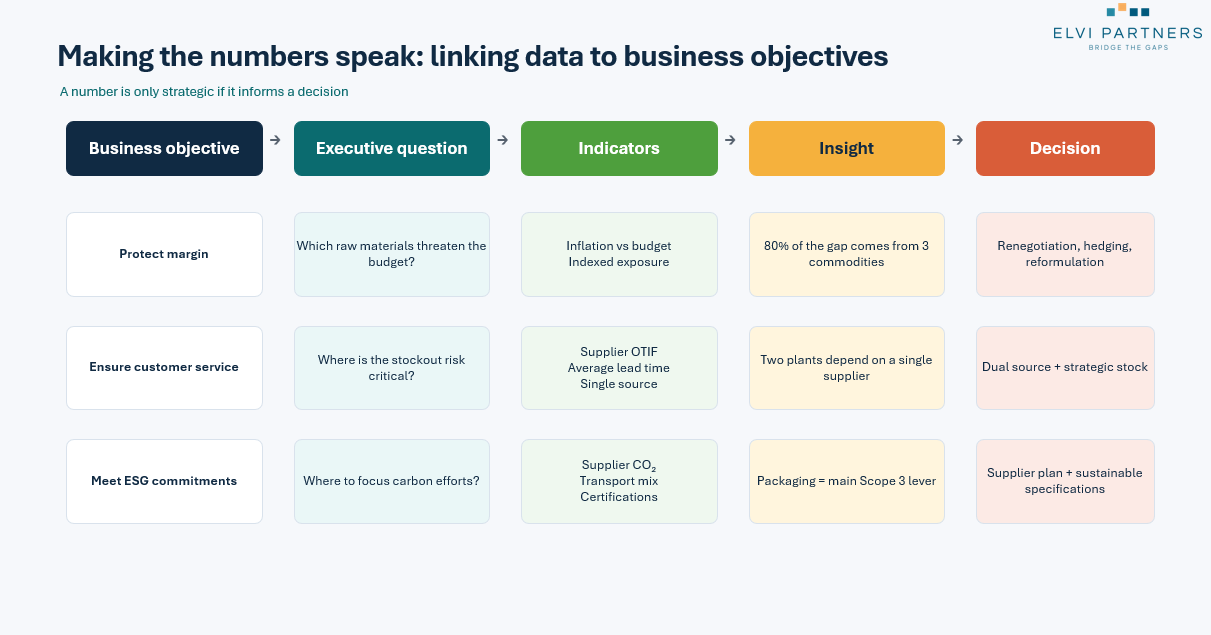
An increase in a raw material price is information. Understanding its impact on margins, identifying which products are exposed and presenting options to mitigate that impact is strategic insight.
A supplier service level is an indicator. Identifying a critical dependency that could put two production sites at risk can lead to a decision to implement dual sourcing or strategic safety stock.
Similarly, data on packaging-related emissions becomes valuable when it helps focus supplier initiatives, review specifications or support the company’s ESG commitments.
A practical methodology is to build a clear chain:
Business Objective → Executive Question → KPI → Insight → Decision
This approach transforms a descriptive dashboard into a genuine management tool.
It also enables Procurement to speak the language of its different stakeholders: EBITDA and cash with Finance, continuity and capacity with Supply Chain, compliance and traceability with Quality, innovation and time-to-market with Marketing and R&D.
Building a dashboard that triggers the right conversation
A strategic Procurement dashboard should not be a collection of charts.
It should help management quickly understand four things:
What happened?
Why did it happen?
What is the impact on the business?
What action or decision is required?
To achieve this, the dashboard can provide different levels of insight: an executive view focused on EBITDA, cash, critical risks, ESG and decisions required; a business view covering plants, business units and priorities; a category view focusing on sourcing levers, suppliers and actions; and finally, a data layer addressing data quality, ownership and traceability.
The golden rule is simple:
Every KPI should have an owner, a reporting frequency, a threshold and a possible action.
Without these elements, a dashboard remains an information tool. With them, it becomes part of the organisation’s decision-making process.
And what about Artificial Intelligence?
AI can accelerate spend categorisation, anomaly detection, sourcing and RFP preparation, contract analysis and supplier risk monitoring.
But AI cannot replace the fundamentals.
It will not, by itself, improve unreliable data, clarify an undefined process or compensate for missing governance. The priority therefore remains to define the decisions Procurement wants to support, identify the data required and establish clear ownership.
Download the methodology and start building strategic Procurement KPIs
To help companies move from theory to action, ELVI Partners and Wagralim are making the presentation used during this Procurement Club session available free of charge.
The presentation provides a structured approach to:
identify the strategic data already available within Procurement;
translate business priorities into meaningful KPIs;
connect Procurement indicators with margin, service, risk and ESG;
structure a dashboard that speaks to management;
progressively transform Procurement data into insights and decisions.
Ready to take your Procurement KPIs to the next level and strengthen Procurement’s voice at Executive Committee level?
Get the full presentation! Fill in your details below and we’ll send the complete methodology straight to your inbox, free of charge.
Procurement becomes truly strategic when it moves beyond explaining its own performance and starts providing management with an external, fact-based and actionable perspective on the company’s priorities.
This is precisely the ambition behind the collaboration between ELVI Partners, Wagralim and the Wagralim Procurement Club: helping Procurement teams evolve from reporting numbers to influencing decisions.